Pencil or Conté Crayon for a Quick Gesture Sketch?
Pencil or Conté crayon for a quick gesture sketch? Compare line feel, easy edits and paper choices to select a tool that keeps your marks lively.
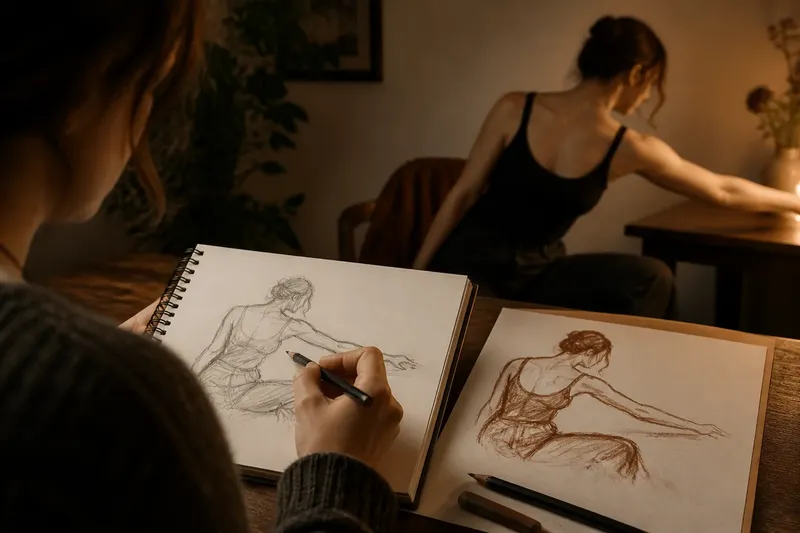
The common mistake in a quick gesture sketch is reaching for the safest tool, then polishing the outline until the pose goes stiff. Choosing pencil or Conté crayon for a quick gesture sketch comes down to how you want your marks to behave: graphite is easy to redirect, while Conté makes bolder strokes that invite commitment.
Pencil keeps exploratory lines easy to change
A sharpened HB graphite pencil can trace a delicate arc for the spine, then shift into firmer marks for the shoulders or hips. A putty eraser can lift a tentative curve, so you can adjust the pose without treating every early line as final.
That flexibility helps when the model’s balance is subtle or limbs overlap. You can test an arm’s direction, soften an overlong contour and place a second line nearby. Resist the urge to erase every uncertainty: a few traces of your search can keep the sketch lively.
Graphite responds to pressure. A relaxed grip makes a fine, pale line; a firmer hand produces a darker stroke. If the pencil feels scratchy or catches on the paper, rotate it to a fresh edge or try a softer grade instead of pressing harder.
Conté crayon makes a pose read in fewer strokes
Conté crayon is a compressed drawing stick with a dry, powdery feel. Its edge can make a broad mark, while its tip can draw a narrower one. That range suits a sweeping torso, a bent leg or the weight-bearing side of a figure.
Its line looks assertive from the start. Rather than tracing the contour repeatedly, you can choose a direction and let the mark stand. A dark stroke against pale paper can make a pose legible with only a few lines.
Conté allows less delicate editing. A kneaded eraser may lift some material, but a heavy stroke can leave a trace or smear if rubbed. Treat this as a feature to work with: decide which movement matters most and let secondary details go.
Paper texture changes how both tools feel
Smooth cartridge paper lets graphite glide and makes small corrections feel controlled. On textured drawing paper, the grain catches Conté and breaks a line into lively flecks; it can also make a light pencil mark look less continuous. Very slick paper may make Conté skid, while rough paper can interrupt a fine pencil line.
For a short session, use a sketchbook surface you already know. If you are choosing a loose sheet, try a small mark near a corner and notice how readily the line starts, whether it smudges under a fingertip and how much texture shows through.
Conté dust can transfer to a facing page, so place a loose sheet of scrap paper between drawings if needed. Graphite can smudge where your hand rests, though it usually leaves less visible powder. Follow the label and manufacturer’s directions for any fixative; ventilation and handling requirements vary by product.
Choose the mark that suits your way of drawing
Gesture drawing catches direction, tilt and weight before small details take over. Pencil encourages a chain of exploratory marks: a long curve, a correction, then a note for the angle of a knee. Conté invites fewer, more legible strokes, with pressure changes to suggest where a form turns or bears weight.
Imagine you are sketching a friend reaching across a table. Start with a sharpened HB pencil and a sheet of smooth cartridge paper. Draw a faint shoulder-to-hip curve, then adjust the reaching arm’s angle with a second line; if the balance now reads clearly, darken the chosen path. For a separate pass with Conté on lightly textured paper, use a broad torso stroke and a second for the arm, leaving the first marks visible. The pencil pass offers more revision; the Conté pass keeps the gesture bold but makes corrections less discreet.
Try not to hold either tool like a tiny outlining pen. Grip the pencil farther back for a looser sweep, or turn Conté onto its side to use more of its edge. A broader movement can describe the gesture instead of dividing the figure into little pieces.
Decide by how you want to handle corrections
Choose pencil if you want to revise a line until its direction feels right. It is accommodating for early studies and poses where overlapping forms need sorting out; a putty eraser can lift graphite without the scraping action of a firm block eraser.
Choose Conté if you tend to overwork a drawing. Its visible marks discourage endless contour-chasing and can help you accept an imperfect stroke as part of the page. Start with light pressure while you learn how quickly the stick deposits colour.
You need not settle on one favourite. Use pencil to inspect and adjust the structure, or reach for Conté when you want movement to read through confident strokes. The useful choice is the one that keeps your attention on the pose rather than on correcting every mark.
Which tool suits your next gesture sketch?
Can you erase Conté crayon?
A kneaded eraser can lift some Conté, particularly when the mark is light, but it may not remove a strong stroke completely. Dab rather than scrub to avoid spreading pigment across the paper.
Is pencil easier for beginner gesture drawing?
Pencil is easier to adjust, which can make it a comfortable starting point while you learn to see a pose as a few simple directions. Conté can also suit beginners who want to practise committing to broader, more visible marks.
Can graphite and Conté share a sketch?
Yes. Try graphite for the initial structure and a small amount of Conté for a strong accent, using paper that handles both materials comfortably.
Which tool is better for a fast gesture sketch?
Neither is inherently faster: a pencil moves quickly during exploration, while Conté can make a pose read with fewer, stronger lines. Choose according to whether you want room to revise or a prompt to commit.
For your next session, draw the same pose once with each tool on the same sketchbook paper. Compare the first line, the corrections you wanted to make and the marks that stayed lively; that direct comparison can help you choose pencil or Conté crayon for a quick gesture sketch based on how you draw.